Tuesday, November 3, 2015

Our Day in Nicaragua

Our day in Nicaragua 

Our scheduled stop in Nicaragua was at Corinto, a small seaside town. The closest inland city was colonial Leon. I joined in a private tour with 8 others from my cruise critic group for an all day tour provided by Julio Tours. 

The man himself, Julio, met us at the ship and soon we were settled in to his air conditioned mini bus. The drive to Leon was about an hour long so on the way Julio told us some things about his life and his country. 

In 1978 he was fourteen years old and living with his mother and eleven siblings near Leon. It was the beginning of September and he was doing what lots of boys his age did - out wandering around the city and it's outskirts.  

At that time the Samosas were ruling the country. It was an oppressive society and there were uprisings throughout the land and a growing guerrilla force that hid out and trained up in the mountains and jungles. 

One night Julio and three of his friends were rounded up
By the Samosas and taken to jail, accused of being guerrillas. The boys vehemently denied this but to no avail. They were held for three months, until early December. During this time they were beaten, starved and for days on end placed in wooden coffins with nothing but a little
air box from which to breathe. 

Once a day, a guard would open the little box door, peer inside, slap their face and pour a few drops of water into their mouth for nourishment. There was no bathing, no toileting, no talking, no eating. One of Julio's friends died. 

In early December they were released and sent back to their homes.  Julio's life had forever changed. On Christmas Day of that same month, in the predawn hours, there came a quiet knock at his door and Julio left his home, joined his two remaining friends and went with another group of young men and a guide, into the mountains to join the guerrilla forces.  Julio hated the Samosas and everything they stood for by now and wished to fight for independence and a better future for his country. He became a Sandinista. 

The years passed - he was sent to Russia for nearly a year for special training. He found the cold winters nearly unbearable but he persisted and eventually rose in ranks in his army. 

By the 1990's he had married and had a young son. Being in the army all of these years he had no other skills, and he could have stayed but his son became very ill and he needed money for special medicine for him, so he took advantage of the army's offer of paying soldiers $1,000 to retire. He used that money to buy the medicine to save his son. 

If anything, Julio is smart and resourceful. He went to Leon and found a job at a bank as a security guard. Soon, the owner of the bank noticed Julio and offered him a job as a bellboy at his hotel. Julio accepted and worked there until 2005. He made more money there because of the tips. He also drove guests places from time to time, when called upon by the owner of the hotel. 

One day the owner of the hotel asked Julio if he could take a few guests on a three or four day tour of the country. Julio agreed. The guests were so impressed with Julio and his knowledge of the country and his good English that they told him he should have his own touring company. 

And so Julio Tours was born. 

Nicaragua is still a very poor country. 45% of the people have no job and live on government handouts but at an incredibly low poverty level. The economy is bad, yet the crime rate is low. The country is over 90% Catholic. There are 5 million people in Nicaragua. About one million live in the capital city of Managua; 200,000 live in Leon. In Leon there are five universities, four of which are free. Many of the young generation are encouraged to leave and so this is what is happening. They are a proud and friendly country but in contrast to Costa Rica, their opportunities seem vastly less available. 

Julio walked us through the more non-touristy places of Leon - we rambled in and out of small bazaar-like markets, viewing fresh fruits, beans, corn, meats and fishes.  The market vendors stared at our small group as if we were creatures from another planet. I was both bemused and sobered. What do they think of us? 

We walked back streets and caught long glimpses of current life in Leon. Barber shops, restaurants, a few hotels, cars and buses mingling with bicycle taxis and horses drawing wagons laden with small pieces of lumber piled precariously high. 

Julio guided us to a restaurant set off the street inside a lovely and peaceful courtyard. Ice cold
beers were passed around along with bottles of cold water. Soon, plates filled with rice and beans and tortillas, along with chicken fajitas, were placed in front of us and we all dug in, hot, tired and hungry from our morning walk. 

After lunch we continued on through the city, visiting the central plaza and coming back into contact with street vendors selling souvenirs. We passed by churches and visited two small museums. Eventually it was time to get back in the van for our return trip to the ship. 

I was deeply moved by Julio's story. Everything else I've seen and heard since then has paled in comparison to what I heard from this man called Julio in Nicaragua.

Pictures of a local open market:


One of Julio's friends at the barber shop.


Leon's central cathedral.


School girls.  Kids go to school 4 hours a day - 1/2 in the mornings, 1/2 in the afternoons, as there are not enough schools to house all the kids at once.

People lined up waiting for a noon meal at a town food kitchen


Julio and an iguana at the market


Our ship's captain Noel O'Driscoll and me!


Wednesday, October 28, 2015

A Day In Costa Rica

Costa Rica


Mmmmm, room service for breakfast!!

We arrived in the port near Puntarenas, Costa Rica, on the Pacific Coast. Costa Rica is bordered on its West by the Pacific and on its East by the Caribbean. In the center of the country is its capital, San Jose. 

The country has a population of 4.2 million.  They hope to be carbon neutral by 2021. They also hold the number one position on the Happy Planet Index as the happiest country. 

Costa Rica literally translates to Rich Coast. Their main exports are mangoes, watermelon, and cashew nuts. Bananas and coffee are also big exports. 

This land has been inhabited since about 10,000 BC. One of the cultural mysteries left behind are thousands of spherically shaped granite bolas, found along its Pacific Coast. The bolas range in size from a baseball to ones larger than a VW bug. 

They've been independent since 1821 and have had no military since 1948. 

I had put together a private tour for the day and had managed to get 19 of us together so the tour company, Gio Tours, had two 12-person vans waiting for us. Our ship arrived in low tide and so it made it quite difficult for passengers to disembark because we had to walk up a very steep ramp from the ship to the dock. And, there was only one door open, so imagine 900 passengers lined up all at once trying to get out. Add to that about 50 or more wheelchairs and electric scooters. It took more than an hour for some people to get off the ship so our tour ended up starting over an hour late. 

All was well, however. Our guides, Jesus and Ray, soon taught us the term Pura Vida, which means pure life and it is a term they use freely and often. Loosely translated it is "it's all good". I guess that's why they rank number one on the happy planet index. 

We started our tour with a short drive to a private home/farm where there were about 70 white-faced Capuchin monkeys. We were able to feed them banana pieces and they would come up to us and gently uncurl our fingers and take the bananas from our hands. Some would climb up us and sit on our shoulders eating their bananas. They were very gentle and sweet.


After visiting the monkeys we had a nice drive south past various plantations and beautiful scenery, finally reaching the Tarcoles River. 
There, we boarded a 30-seater small covered riverboat (think Disney's Jungle Boat) and set off on a nearly 2-hour River cruise to see crocodiles and birds. 

And did we see crocodiles! Mama mia yes we did! Lots of them, from baby ones sunning themselves on logs to crazy big ones hungry for a snack. Our boat driver would pull us up next to the bank, get out with a big piece of chicken and "encourage" the croc to come up out of the water and "jump" for that chicken. Yikes!!!  

It was a really nice river cruise. Our boat had a roof so we were shaded and the open sides allowed a nice breeze to keep us feeling cool. We saw lots of beautiful birds, plants, horses and even a young Brahma bull running alongside the river bank. The river route took us all the way out to where it meets the ocean.


After this we piled back into the vans and headed up the road a little bit to a restaurant for a nice lunch. We had meat, rice, black beans, potatoes and green beans and salad. Washing the food down were delicious mango smoothies and some local beers. 

After lunch we stopped off at a private resort called Nativa where we were able to drive out to a lovely vista. From there we could see across east towards the mountains and north and west along the ocean coast.


We were able to enjoy a sighting of a group of lapa rojas. They are huge red parrots of a sort and they were busy flying around the trees. You can usually find them in pairs (they mate once, for life) near the tropical almond tree, as that is what they enjoy eating from. 

It began to rain quite heavily while we were stopped at a store shopping for some coffee and other souvenirs. Our day was drawing to a close so we got back into the vans and turned towards the port.


One of our guides, Jesus, suddenly yelled excitedly to the driver to stop, and he hopped out of the van and ran across the road to a small tree  he pulled off a large lead and brought it with him back to the van. We then drove over to an open and covered area and got out. Jesus then had us all rub the lead with our hand, down and up. Then we felt our hands and they were butter soft! Next, though, he began testing up this bright green leaf into small pieces. He bunched the pieces into his fist and began squeezing really hard. Giancarlo the driver poured a few drops of water from time to time into Jesus's fist and suddenly, as Jesus squeezed the liquid into his other hand, the clear water turned blood red! It was a chemical reaction of the water and the plant leaves.  Really cool!


Soon back at the port, our lovely day and small taste of beautiful Costa Rica was ending. Oh well, Pura Vida!!!


Sunday, October 25, 2015

Transiting the Panama Canal

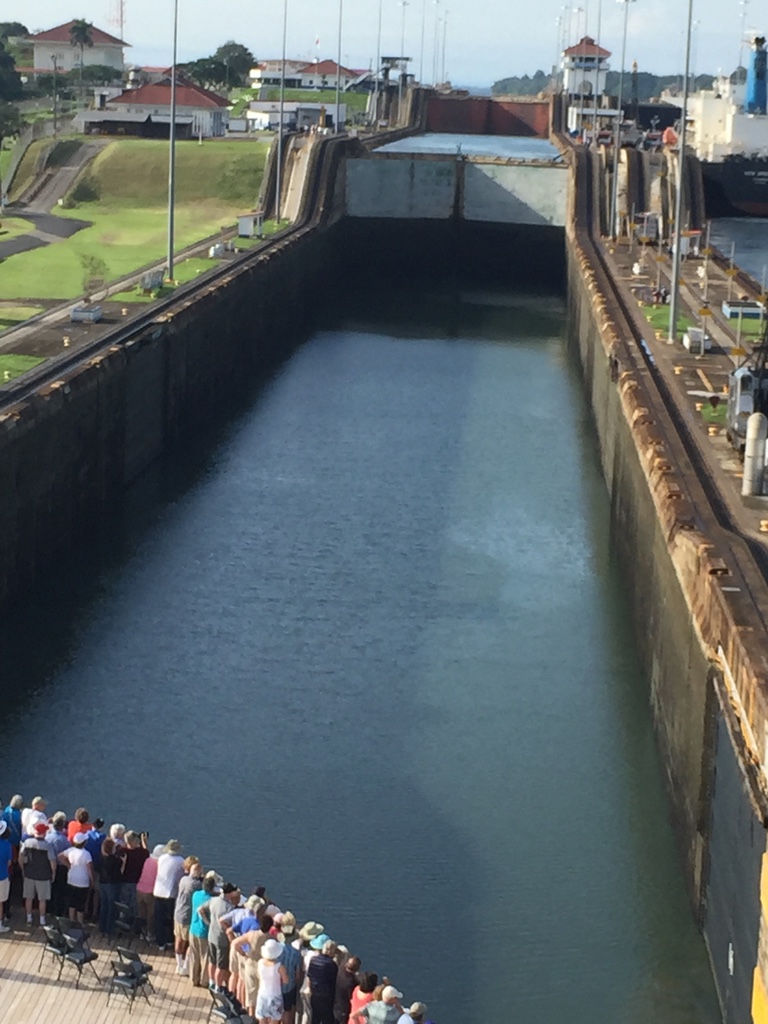
Today was our Panama Canal transit. It started early. We entered the Canal about 5:00 AM and got up on to the firs set of Locks (Gatun) about 7:30. There is a steady amount of traffic flow so we had to wait our turn. 

Here's a brief history of the Panama Canal:

The whole purpose of the Canal was to significantly shorten the amount of time for ships to travel between the Atlantic and Pacific Oceans. Instead of having to travel south around Cape Horn, which was pretty hazardous was much longer as well. 

The French made the first attempt at building a canal through this Isthmus of Panama. They began in 1881. However, they lost over 25,000 people working on it, primarily due to malaria and yellow fever. Before work could continue there needed to be a solution found to dragster dice the deaths from these diseases. And to do that they needed to find out what caused the diseases. 

Eventually it was discovered that the mosquito was the cause so efforts were undertaken to eliminate both the number of and the spread of mosquito bites which caused the disease. 

The French went bankrupt and no further significant efforts were made until the U.S. acquired the rights to build it. We can credit Teddy Roosevelt for making this happen. Much like President Kennedy did in the early 60's with the push for landing a man on the moon, so did Teddy regarding the Canal. He sent his Secretary of State John Hay to negotiate a treaty with Colombia (owner of Panama at the time) and in 1903 the treaty was done. 

It took about 10 years to build the canal. In contrast to how many men were lost to disease during the French attempt 20 years earlier the U.S. only lost about 5,000 workers. The successful mitigation of malaria made the difference. 

The Canal was completed and opened in 1914. It was finished six months early and came in under budget. And not a hint of scandal about the finances.  Now when was the last time that happened???!!!!

The U.S. Maintained control over the Canal until a new treaty was signed in 1977. There was a long transition period and full control was finally handed over to the Panamanians on 12/31/1999. The Canal remains today, one of the chief sources of income for Panama. 

That was the short version of the history of the Canal. I learned a lot more during the talks I attended but don't need to bore you all more than I already have on the subject. 

The Canal consists of artificial lakes. Gatun Lake in particular is an integral part of the success of the Canal. It was formed by building a dam and then the locks used to raise ships up 87 feet from the Atlantic Ocean to the lake are fed from the nearby Gatun River.  

There are a total of three sets of locks across the entire canal. The crossing is 88 kilometers, nearly 50 miles long.  It takes about 15 hours for a ship to transverse the Canal depending on traffic. 

In 2007 work began to expand the width of the locks so that the larger container ships and mega size cruise ships can get through. The current width limitation is about 110 feet wide. Our ship just barely squeaks by and we're a small ship. The new Canal locks will be 55 meters wide (180 feet). 
It is slated to open in 2016.

Some shots of our transiting, and then of Panama City on this night of a full moon.


Ft. Lauderdale to Panama Canal

Florida to Panama Canal

We were supposed to leave Ft. Lauderdale at 4:00 PM but during the day we had a hydro and then an electrical power failure onboard so we ended up leaving nearly 6 hours late. 

The captain did his best to make up the lost time but we ended up arriving into Cartegena 2 hours late. It was already a short day port visit. We got there at 9 and left at 1. We had a private tour booked and the tour operator, Dora, adjusted things and off we went. We toured the old walled
City and Dora gave us some interesting history of her city. 
Cartegena was settled by the Spanish in the early 1500's. Don Pedro Heredia was the explorer who named the city. The bay at the entrance to the city looked like the bay from his hometown of Cartegena Spain so he named it after that. 

Trade flourished over the next two centuries between Europe and South America and Cartegena was strategically located in a great spot so the city grew and flourished as well. 

In 1819 Colombia was liberated from Spain by Simon Bolivar, whom they still consider their national hero.

Here are some pics of our short tour/visit in Cartagena:


Our two days at sea were pretty uneventful. I developed a bit of a head cold a couple of days prior so I just tried to take things slow. I did learn how to play Bridge and Mahjong however. When I say "play" I mean that ever so mildly. In Bridge for instance, indoor yet know how to bid but I did learn the mechanics of the game. In Mahjong I learned a lot. It's a bit complicated because you've got to find a "plan" and then commit to it. To me it's a little like gin rummy but using tiles. There are a lot of rules though!

There's a history and political specialist onboard so every sea day he does a presentation. On both days he gave talks about the history of the development of the Panama Canal. I attended both of those. 

All in all its been a good cruise so far. 

Next up will be our transit through the Panama Canal. 

Wednesday, October 21, 2015

Port Canaveral and Fort Lauderdale

Port Canaveral and Fort Lauderdale

Spent the day in Port Canaveral on a ship tour to the Kennedy Space Center. It was an 8 hour tour. 

It's a very impressive place and the tours well done. We got to see a number of Saturn rockets as well as the launch pads and the roads that the tractor thingies carry the missiles and shuttle to the launch pads. The roads are specially made as these spacecraft weigh millions of pounds. 

We also spent time in the Atlantis area where we saw the retired shuttle and got to use simulators to try to do things like land the shuttle (I crashed multiple times). 

Finally we saw a very cool 3D IMAX movie detailing the current Orion project which is all about sending manned spacecraft to Mars. The plan is for 2030. How exciting!


I managed to pick up a sore throat and runny nose overnight so today in Fort Lauderdale I was dragging a bit. 

This is a big port where a bunch of passengers got off (they had started in Quebec) and about 600 passengers got on. I had signed up for a land and water tour and spent an enjoyable half day driving through the city and learning some things about the history of this area. 

We also got to go on a riverboat cruise for about 90 minutes up the Intercoastal waterway where we saw some gorgeous waterfront homes along with matching mega yachts. I posted a number of photos on my Facebook page. When I get home I will post pics here but due to limited internet connectivity I can't do it now. 

We leave shortly, headed for Cartagena Colombia. We have two days at sea to get there. We will pass very close to Cuba on our way out tonight.


Followers